Intro
If you are reading this then chances are you are a brand new (or returning) D&D player, welcome to the table! What is to follow is my attempt to condense down all essential first time D&D knowledge into a simple and easy to follow guide. Just remember, the best way to learn D&D is by playing it! So make a character, learn what you can about gameplay, and any gaps in your knowledge will be filled as you play!
If you wish to gain a high level overview of the game before any further reading, I recommend you watch this video by Ginny Di on YouTube, it is intended for people using the 2024 rules so a few words are slightly different however pretty much all of the explanation of how the game is played is the same.
Technical Info
- My D&D games use the D&D 5e (2014) ruleset, This is not to be confused with the D&D 5.5e (2024) ruleset, It is easy to set D&D beyond to use the 2014 rules only so that you do not need to worry about it, I will go over this when I talk about D&D beyond later.
What is D&D / How do I play?
High level D&D Description
D&D Is a TTRPG (Table top roleplaying game), Which is to say that you play the game by sitting around a table narrating your actions. In the case of D&D there are 2 types of players;
- Player characters
- Dungeon master A dungeon master is responsible for narrating the overall story, controlling NPCs (non-player characters), and overall running the game. A Player character (That’s you!) is responsible for controlling and narrating the actions of their individual character.
Actions as a player character
As a player you can essentially break down everything you do into 2 categories:
Out of combat
When out of combat, players are free to perform various actions at will, these actions include but are not limited to:
- traveling from location to location (often within a town or settlement)
- speaking with NPCs (the player speaks as themselves and the DM speaks as the NPC the player is talking to)
- Bartering (functions the same as speaking with NPCs)
- exploring locations (either publicly or by sneaking around, this often includes skill checks which we will talk about later)
- Performing other miscellaneous actions. Some of these actions will require skill checks to perform, while others are just assumed possible, we will talk about skill checks later.
In combat
During combat the game becomes turn based, The order of turns is determined by an initiative roll, which is a roll of a D20 + plus your initiative modifier (we will speak about modifiers later when we speak about skill checks). I will explain combat further in one of the next sections.
The Dice!
If you know nothing else about D&D you will likely at least know 1 thing - there are lots of dice! these dice like in any game are used for generating random numbers, these numbers include the damage of weapons, the amount of heath regained by drinking a potion, etc. every item, spell, and weapon that involves a dice roll specifies which one it needs by identifying the die as a “D” followed by the number of sides, for example a 6 sided die is referred to as a “D6”, a 12 sided die is referred to as a “D12” etc.
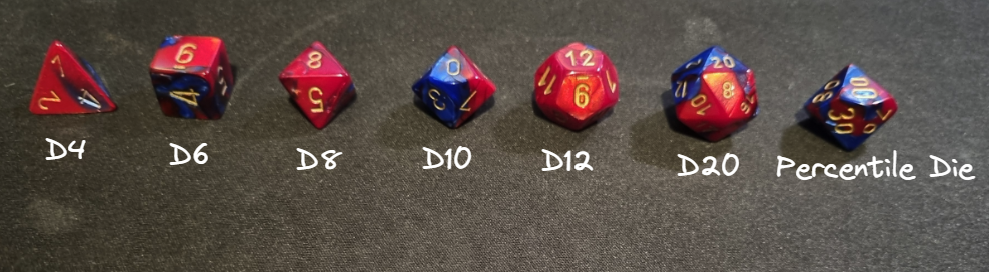 Notes:
- 0 = maximum value: You will notice that the D10 has a 0 on it, it is important to note that this 0 actually represents 10.
- The D100: there will be times where you DM, or a class feature ask you to roll a “D100” you will notice that there is no 100 sided die in a standard set of dice. this roll is actually done by rolling the D10 along with the percentile die, adding the resulting numbers together. It is important to note that when rolling a D100 the 0 actually represents 0 instead of maximum value, unless you roll entirely 0s, in which case you have rolled a perfect 100
- Multiple Dice: sometimes a weapon, spell, etc. Will call for rolling multiple dice, they will list this by writing the Number followed by the type, for example: 3D6 means roll 3 six sided dice.
You do not need to buy any! if you have your own that you want to bring then that is totally encouraged! however I have plenty of spare dice for you to borrow if you like :)
Skill checks / Saving throws
At this stage I have mentioned skill checks a couple times, D&D contains a series of skills used to attempt various tasks (Acrobatics, Deception, Stealth, etc.) every character has a modifier (sometimes positive, sometimes neutral, sometimes negative) for each of these skills listed on their character sheet, these are determined during the character creation process (more on that later).
To perform a skill check, roll a D20, and add your modifier for the relevant skill, for example if your DM asks you to make a stealth check, then you roll a D20, and apply your stealth modifier to the result of the roll;
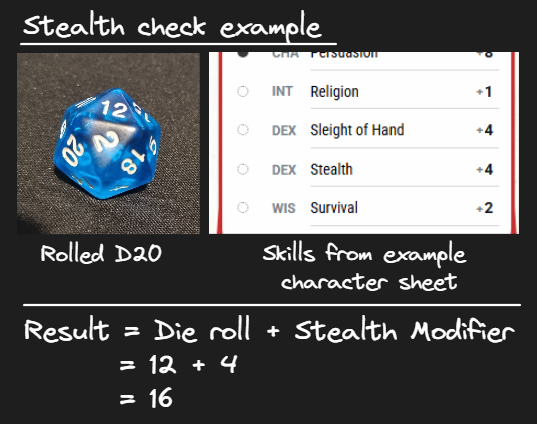 After you roll your skill check and add the modifier you tell your DM the final number, they will then tell you if you failed or succeeded in what you were trying to do. It is important to note that in order to make a skill check to attempt something you must first be asked / approved to do so. for example you may say that you want to try and break down a door, your DM will ask you to make a strength check (for example), then you will do it and say the result. You can not however simply roll a strength check without asking and then say “hey I wanna knock down the door also I rolled a 16”, the reasoning for this will become clear as you play the game, but it’s mostly about keeping discussions / options clear as well as giving your DM the opportunity to tell you that you can not do something / give your fellow players the chance you talk you out of it.
If you wish to accomplish a task in a certain way then you can request the specific skill check, for example if you want to get through a door by picking the lock, you can specifically ask your DM “Hey I want to try and get through this door, can I make a slight of hand check to try picking the lock on the door”. Requests like this will feel more natural to you as you keep playing the game, but at the start it is totally fine to just say “hey I want to try and get through this door” and let your DM tell you what check to make.
You should also note that not every action in the game requires a skill check, for example if you want to just pick up a simple object or walk across a room for example, you just say that you do it, no check required. If you feel unsure as to if you can perform an action, just say that you try to do it and the DM will tell you if a check is required, you will get a feel for it as you play.
Saving throws function the exact same way to skill checks, the only difference is that it is typically called a skill check when proactively trying to do something, while it is typically called a saving throw when reacting to something. For example you may make a dexterity skill check to try and throw something at someone, while that someone may make a dexterity saving throw to try and dodge it. The mechanics are exactly the same, just different words and they often get interchanged.
Critical hits / success (natural 20) and critical miss / failure (natural 1) have different effects depending on your DM, you can read about how they work in my games in my D&D house rules.
Combat!
Okay so It’s time to go more in depth on how combat works, I will break this up into sections including how it starts, what you can do during combat, how battle maps work, and how combat ends.
How combat starts
Combat can be initiated by the players or by NPCs, it is often started either with an act of violence (either by the players or to the players) or by simply declaring it with words, you will know that combat has officially started when your DM tells you “roll initiative” when this happens, roll a D20 and add your initiative modifier to it, this bonus is listed on your characters sheet.
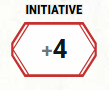 Once you have your initiative score, do your DM a very kind favour and rather than calling it out at the same time as everyone else, hold on to it and wait while they go around the table and ask for it (they will love you). The order of turns in combat is determined by taking everyone’s initiative roll (both the player’s and the NPC’s) and listing them from highest to lowest (your DM will do this).
What to do on your turn
There are 3 things a player can do on their turn, which can be done in any order, these 3 things are: Move, Take an action, And take a bonus action. I will detail each of these below.
Action
You action can be seen as the main part of your turn, it is typically used for making an attack or casting a spell, however you may choose to use your action to hide, help another player, etc. I will just be explaining how attacks and spells work, but you can find a full list of what you can do with your action here
Making an attack
To make an attack, you first need to
choose a weapon / damage dealing spell from your character sheet, and then an enemy that is within range (range is either determined by asking your DM how close they are in the case of playing in “theatre of the mind” or by counting squares if playing on a battle mat, more on that later).
you then roll a D20 and apply your attack modifier, this can be found by next to the weapon on your character sheet
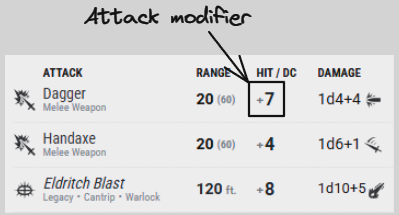 This is just like making a skill check except you use the attack modifier for the weapon you are using rather than the modifier from a skill, once your have your final number tell the DM what it is, they will then tell you if it hit or if it missed.( If the attack missed then your main action is over, you still have your bonus action and movement though! if you have not used them already)
If your attack hit then you roll damage! the damage is listed next to the attack modifier, weapon damage is listed in the following format:
Amount of dice | Type of Dice | Additional modifier.
Examples: 1d4+4 = Roll one 4 sided die, add 4 to the result. 2d6+3 = Roll two 6 sided dice, add them together, add 3 to the result. 3d10+5 = Roll three ten sided dice, add them together, add 5 to the result etc.
It is important to note that when rolling damage for a spell that uses multiple dice, you only get the damage bonus once, regardless of the amount of dice, so if you are rolling 2d4+2, you only add that +2 after add the two D4 results together, not once for each die, there are certain exceptions to this rule for attacks that hit the target multiple times, such as eldritch blast.
Tell your DM how much damage you ended up with, and what type of damage it was (this is also listed on the attack right next to the damage amount) The DM will then subtract the amount of damage you did from your targets hit points (you do not get to see the enemies hit points, but the DM will tell you when they die)